|














 Address: Baker Street, St. Augustine Telephone: 868-662-4832 E-mail: mail@universityschool.edu.tt
|
About the University School
|
|
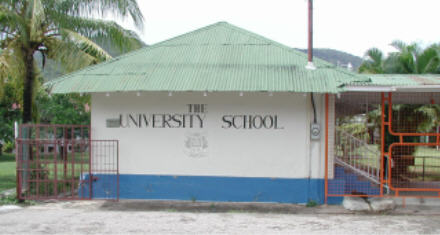
Introduction: The University School is co-educational school for children from the age of 4 years up to the age of admission to secondary school. The University School started in 1954 with its initital aim to provide educational facilities for children of the senior staff of the Imperial collecge of Tropical Agriculture (ICTA). By 1966, the ICTA had been replaced by the University of the West Indies (UWI). While first priority is therefore given to children of members of the staff of The University of the West Indies, others are accepted up to the limit of numbers. Part of the land on which the school is situated iss owned by the University. The School is approached by way of Baker Street, which is off Gordon Street, St. Augustine. It is a private non-profit making school operated by The University School Association. The management of the affairs of the Association is vested in a Council comprising five elected members and an honorary secretary. The School Principal is an ex officio member of the Council. The members of the Council are the directors of the Association. Mission Statement: The University School is devoted to the development of healthy, enlightened, self-reliant children in an environment of caring, committed teachers and families. Enlightenment includes the nurturing of intelligence and the reminement of sensibility to the customes and moral and cultural values of all members of society. Self-reliance encourages confidence in the use of personal initiative and of what is available in the environment. Aims and Objectives: General objectives:-
Curriculum objectives:-
Curriculum: This is a preparatory school whose aim is to provide as rounded a curriculum as possible and to prepare children for entry into secondary schools after having sat the Schools' Entrance Examinations (SEE) formerly known as the Common Entrance Examination. At no time is a child pushed beyond the limits of his or her mental ability. Attention is paid to character training, and it is thought that encouragement is as valuable as reprimand in achieving this aim. The subjects taught are Reading, Writing, Arithmetic, English, Spelling and Dictation, Poetry, Social Studies, Art, Science, Religious Knowledge and Physical Education. Music appreciation and singing are also on the timetable. A well-equipped music room ensures exposure to various musical intruments including steel pands, percussion, guitars, quatros and recorders. All children from Junior 2, approximately age 7 and upwards, are given swimming instruction. Optional games and other activities are available after school. These include football, cricket and dancing. The school has a well-stocked library and children are expected to borrow books for leisure time reading. There is also a small computer laboratory. A large auditorium is used for various school functions and is available for rentals outside school hours. The shcool has a playing field for games which is also equipped with playfield equipment. Homework is normally set from Junior 1 upwards. parents are asked to sign homework note books each evening after they have ascertained that the work has been completed. Classwork books are made available to parents on request to the relevant teacher. Classwork books made available to a parent must be returned to the school undamaged on the following shcool day, otherwise the parent mayb e responsible for replacement. The school's aim is to develop healthy, intelligent and self-reliant children with a sense of responsibility, by developing the mind, body and character of the child. School Year The school year begins in September and consists of three terms. there are vacations of approximately three weeks at Christmas and two weeks at Easter, as well as a longer vacation during July and August. A chool calendar is issued at the start of each term giving details of these and other events. School Hours These are from 8.25 a.m. to 2.25 p.m. During the lunch break (11.40 a.m until 12.25 p.m) most children stay at school. There is another short break (10.05 a.m. until 10.20 a.m.) during the morning session. Children are required to arrive punctually and are expected to be in school when the bell rings at 8.25 a.m. Admission of Students The normal age for admission to the school is at 4 years. Children entering the Reception class will be expected to be at least 4 years and less than 5 years on the 31st August of the year of entry. Normal entry will be at the beginning of the first term of the school year, i.e., early September. Application for entry to the school must be made on the official application form available from the school. An application fee is charged, the amount of which is determined from time to time by the Council of the school. If more applications are received than places available, the priority for entry to the Reception class is as follows:-
Within the above three priorities, if more applications are received than places available, preference will be given in order of receipt of application fees. All application fees which were paid before the applicants reached the age of 2 years shall be considered as having been received on the same day (i.e September 1 after the second birthday of the applicant). Entry to classes other than Reception for children 5 years of age and above will be restricted to any places becoming available. If places are available, the order of priorities described above will be followed if more applications are received than places available. If after followinf all priorities for entry there is a tie for the last place or places available, the tie shall be resolved by the Council as it deems fit. Council may alter the age and conditions for admission from time to time if it sees fit to do so. Nothwithstanding the above priorities, Council will refuse admission on the following grounds:-
FEES Parents are asked to give notice as early as
possible of any probability of the withdrawal of a pupil.
If notice
is not given, in writing, within 7 days after the end of term,
parents will be considered liable for the next term's fees. SCHOOL UNIFORMS Girls: Green dresses with matching knickers.
Uniforms are on sale at the school.
Dress for older girls should not be too short and
should be 2.5 cm off the ground when the child kneels.
Hair ribbons or ornaments should be white, green or
clear in colour. If
the hair line is below the level of the collar the hair should
be tied back. Closed
brown shoes are required with brown or white socks.
Jewellery should not be worn except for a watch and, if
the ears are pierced, small stud earrings. Boys: Green shirts available from the school; khaki shorts and closed brown shoes with brown or white socks. No jewellery apart from a watch. Physical Education Uniforms Junior I to V: House jerseys, navy blue shorts, white socks and white gym shoes. Reception and Prep:
White U.W.I. school jerseys, navy blue shorts, white
socks and white gym shoes. Uniforms should conform to the standard pattern
in all respects, and all children attending the school must
wear uniforms. All
personal items, including uniforms, must be clearly inscribed
with the name of the child. ABSENCE FROM SCHOOL Apart from illness children should not be absent
from school, for any reason without
previous explanation. Parents will be provided with a list of
textbooks, stationery and other school requirements.
These items must be purchased in time for the beginning
of each school year. The school has a Parent Teacher Network (PTN)
which organises a number of activities and events and also
ensures close working relationships between the staff and
parents. All parents of children at the school are eligible to join
the PTN on payment of a very small fee.
It is recommended that all parents join. Parents should follow the following lines of communications in registering their concerns:-
Each teacher makes himself or herself available
to parents at mutually convenient times.
To assist in identifying these times, each teacher must
notify parents of at least 1 hour per week on which
appointments can be made.
If these times are not convenient to any parent, then
the teacher or principal must make an appointment at another
time which is mutually convenient and is within 72 hours of
the request for an appointment. Parents or guardians are required to ensure the
following:-
Parents or guardians should not attempt to
reprimand or discipline children, other than their own
children, who are attending The University School or otherwise
under the supervision of a member of staff of The University
School. Any
delinquent behaviour by such children should be brought to the
attention of a member of staff. The University School advises parents and guardians that all students should be covered by an Accident/Injury Insurance Policy. The school will not be liable for any injuries that may occur during or after school hours on the school premises. In the event of an emergency and
the parent cannot be contacted the child will receive medical attention from qualified
medical personnel at the parents’ cost. The parent/guardian
will be informed of the cost to be paid.
.................................................................
The University School Association Ltd.,
I have read the Prospectus dated April 2001 and
I hereby agree to abide by the terms and conditions as set
therein. Name (Block capitals) ........................................………………………….......
Signed...............................................…………………………............................
|
|