|














|
Parent Teacher's Network Panel
Discussion: |
  |
“Educating the Primary School Child: Practical Considerations for Holistic
Development and Successful Outcomes” This was
the title of the Panel Discussion held on Saturday, March 18, 2006, by the
Parent Teacher Network of the University School, Baker Street, St.
Augustine.
The objective of the Panel Discussion was to provide information to stakeholders, especially parents, guardians and teachers, which would allow for curriculum development strategies that were appropriate for primary school children, while balancing concerns voiced by parents and guardians around the need for adequate preparation for the Secondary Entrance Assessment (SEA).
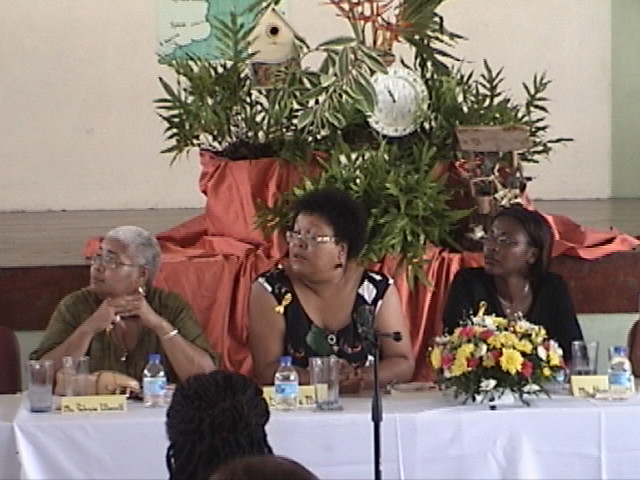
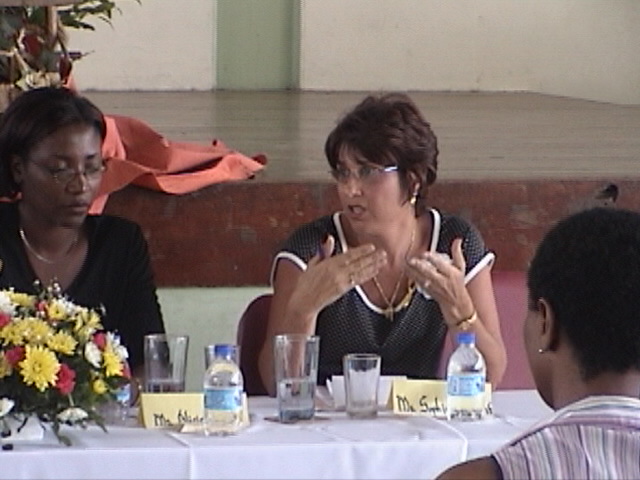
The Panellists were Ms. Pat Worrell, lecturer in Curriculum at the University of the West Indies, St. Augustine and member of the National Curriculum Council of Trinidad & Tobago; Dr. Karen Moore, Child Psychologist; Ms. Alicia Hoyte, Clinical Psychologist and Parenting Facilitator; and Ms. Sophie Barcant, Parenting Facilitator presenting on the Love and Logic perspective. The moderator of the proceedings was Dr. June George, Senior Research Fellow in Science Education at the School of Education, the University of the West Indies, St. Augustine.
In a questionnaire administered to parents in preparation for the panel discussion, the conflict they faced between supporting a developmentally appropriate curriculum that was diverse and holistic and preparing their children for SEA was obvious.
 |
More than 95% of the parents who answered the questionnaire said their children were happy with the school and over 75% felt that their expectations of the school were being met with many parents identifying areas of satisfaction that their children were obtaining an all-round education with a diverse curriculum. On the other hand many parents identified concerns around the preparation
of SEA exams, with some explaining during the panel discussion, that in spite of their need for a well-rounded child, the education system in Trinidad and Tobago demanded that they also focus on this final and major assessment of the primary school child.
There was general consensus among all of the presenters that a holistic education was necessary for the development of a rounded individual and that a person's success in life did not always correlate with academic achievement in school. The tendency to focus only on numeracy and literacy skills robbed children of the opportunity of attaining other skills that they needed for success in life and often contributed to psychological and anxiety problems that resulted in an inability to cope with life in general.
Ms. Worrell agreed with parents that their concerns were both valid and legitimate regarding the inappropriateness of the Secondary Entrance Assessment as the only, or even the major, form of evaluation of the curriculum and of students’ development and preparedness for secondary level education. She also agreed that children were often being prepared for this exam in a manner that was incompatible with the idea of a diverse, holistic curriculum, which was deemed to be developmentally appropriate for primary school children.
In this regard, she warned them that “hard choices” would have to be made as to the kind of curriculum that would be developed for the school, and for the country. She urged parents to ensure that they were informed about the national curriculum requirements and the extent to which this was in keeping with the kind of educational development they wanted for their children. She advised that they use the public forums to make their opinions and desires known, since structures were not static and there was always room for change.
Dr. Moore pointed to the psychological damage that attended children whose different learning styles and need for exposure to different teaching methods were not met. Not only were they unfairly branded as underachievers and not allowed to enjoy success in their areas of strengths, but their potential remained untapped. On the other hand, children who were drilled to focus only on the passing of exams tended to lose their capacity for creativity and critical thinking, skills which she pointed out were increasingly required in the work force at the highest levels, both locally and internationally.
Parents were encouraged by Ms. Hoyte, to look within themselves and examine the extent to which their own fears and anxieties cause them to place undue pressure on children, especially around the passing of exams. She explained that anxiety reduced coping skills and the ability to think clearly. Parents who were anxious and passed this anxiety on to their children were reducing the chances of achieving the very objectives which they so badly wanted. She explained that body language was a major means of communication; therefore, while parents might have learnt to control their tendency to verbalize these anxieties to their children, they were nevertheless able to communicate these anxieties to their children non-verbally and often, unconsciously. Relaxation techniques in stressful situations around exams were therefore advised for both parents and their children.
Finally, Ms. Barcant, explained how parenting styles differed and could work to the detriment or advantage of our children. Using the language of the Love and Logic approach, Ms. Barcant explained that many parents were either ‘helicopters’ – hovering over our children, ready to rescue them in any situation, or ‘drill sergeants’ – barking orders and constantly telling them what to do. The Love and Logic approach encouraged helping children to learn responsibility and consequences, using the consultative approach. Encouraging problem solving and learning through mistakes, when the consequences are not likely to be disastrous, were all means of ensuring the development of independent, responsible individuals in the long run.
Noting the large turn-out of parents at the meeting, Dr. George commended parents for their obvious interest in their children’s welfare. She also encouraged them to continue supporting the school in its quest to achieve a balance between holistic education and academic achievement, since she could attest to the importance and usefulness of this approach based on the experiences of her own children who attended the school.